
When the wound is tied to your identity
You shouldn't have to choose between a therapist who genuinely gets your identity and one trained to treat what's underneath it. The intersection is where this practice lives.
For a lot of us, the trauma and the identity were never two separate stories
Family that pulled away. A faith that had no room for you. Years of editing yourself before anyone could see you, scanning the room before you spoke, softening your voice, holding the truest part back until it felt safe. None of that is a side issue to who you are. It shaped a nervous system that learned the world wasn't safe to be fully yourself in. What you're carrying is an injury that makes complete sense, and it can change with the right work.
What identity-rooted trauma actually looks like
It often doesn't look like a single terrible event. It looks like the chronic, background cost of never being quite safe enough to relax into yourself:
The automatic, familiar bracing that happens before you walk in anywhere
A pull toward people who are hard to trust or hard to leave
A sense of being not enough, or too much, that’s been there longer than you can remember
Feeling alone even inside the community you fought to find
The exhaustion of holding yourself together, and not knowing who you'd be if you stopped
And often: "my childhood wasn't that bad." Maybe it wasn't, on paper. But you grew up learning that some parts of you were a problem to be managed, and a body that learns something like this early has trouble letting go of it. The minimizing can be protective for a while but it burdens you with a false belief that you’re to blame for things feeling off, or harder than they “should” be. You don't need a dramatic story to get support or to heal.
You may have looked for this before and had to compromise
A lot of people at this intersection have made a trade. You found an affirming therapist who was knowledgeable and kind but didn't really do depth trauma work. Or you found a skilled trauma therapist you spent the first months educating, walking them through your pronouns, your relationships, your community, until it wasn't worth it.
My practice exists in this precise intersection. I won't treat your identity, your brain wiring, or how you love as the problem to be managed, and I won’t need you to shrink yourself to do the depth of this work.
Queer and trans clients: your identity stays the given. We work with what developed around it, the injuries from adapting to a world that wasn’t safe.
Neurodivergent / AuDHD clients: sometimes there's more to the story, and trauma is often it. Plenty of neurodivergent people have had every hard thing waved off as 'just' their wiring, so the trauma sitting alongside it never got tended to, and that's what we can finally turn toward.
ENM/poly clients: the structure you're in isn't a problem. We can look at what's actually hard without treating how you love as a variable to fix.
How the work actually goes
My primary tools are EMDR and Internal Family Systems (IFS), and the reason they fit this work is the same reason talk therapy alone often doesn't: what you're carrying sits underneath talking, held in the body, in the bracing, in the parts of you that learned to protect you by going quiet.
EMDR is one of the most thoroughly researched trauma treatments we have, endorsed as a first-line PTSD treatment by the World Health Organization and the VA. It helps the nervous system finish processing memories that got stored without resolution, so the old alarms stop firing in the present. You don't have to narrate everything in detail for it to work. For trauma built up over years rather than a single event, I pace it carefully and pair it with IFS.
IFS gives a respectful way to know the parts of you that took on protective jobs early: hypervigilance, people pleasing, withdrawing or going quiet. For people whose protectors formed around hiding who they are, meeting those parts with compassion and respect helps them to feel safe enough for change to happen.
Because you won't spend the work explaining or defending your identity, we can go straight to the deeper work. The deeper work doesn’t have to be compromised away.
Supporting research
A short note for anyone who likes to know the evidence:
EMDR is an established, recommended trauma treatment. It's endorsed for PTSD by the World Health Organization and named a first-line trauma-focused therapy by the U.S. Department of Veterans Affairs and Department of Defense, with a substantial base of randomized controlled trials behind it. (VA/DoD Clinical Practice Guideline for PTSD, 2023; WHO, 2013; NICE guideline NG116, 2018; Chen et al., 2014, PLOS ONE: meta-analysis of 26 RCTs.)
Its use for childhood and complex trauma is active, promising research. For trauma that built up over years rather than from a single event, the evidence is promising and still maturing, and the field continues to test and refine EMDR for these presentations. (de Jongh et al., 2024, "State of the Science: EMDR Therapy," Journal of Traumatic Stress, 37, 205–216.)
The link between identity and this kind of wound is well-documented. The minority stress model describes how the chronic strain of prejudice, and never being quite safe to be yourself, contributes to the mental health burden many queer and trans people carry. First developed for sexual minorities and later extended to gender diverse people, it puts a research name to the strain this page describes throughout. (Meyer, 2003, Psychological Bulletin, 129(5), 674–697; Hendricks & Testa, 2012, Professional Psychology: Research and Practice, 43(5), 460–467.)
I'm glad to talk more about any of these, or additional research, in a consult.
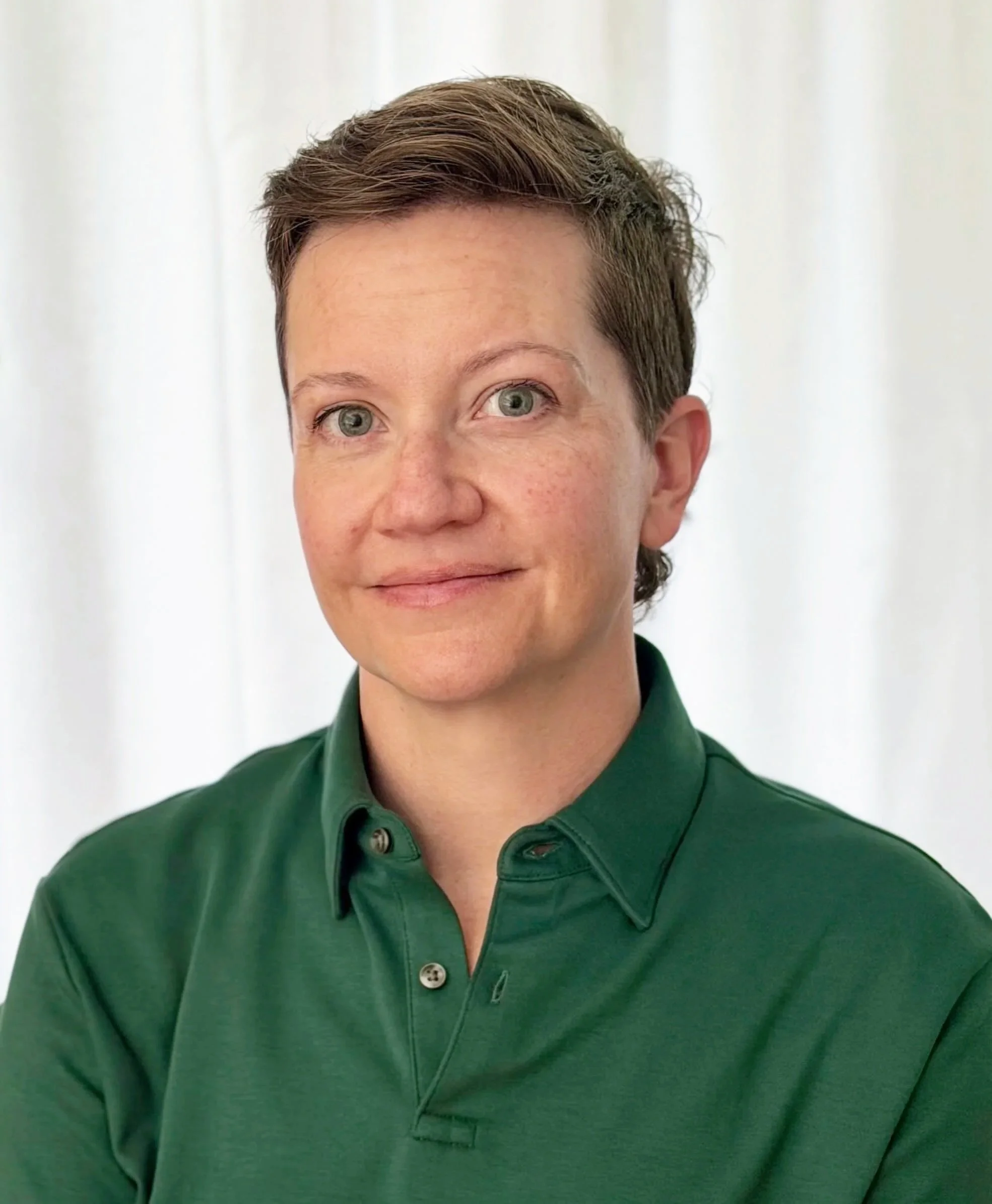
Alex Fuller, LPC
I'm Alex (they/them). Queer and trans affirming care is something I trained in, and it's also personal to me. I came to this work through my own healing, and I understand what it's like to look for support that actually meets you where you are instead of asking you to translate yourself first.
You won't have to educate me, defend who you are, or wonder if I'm quietly making assumptions. We can get to the actual work.
If you've spent years explaining yourself first, there's room here to put that down.
A free consultation is the first step. There are no forms or commitments, just a conversation to see if we're a good fit.
FAQ
-
Both, on purpose. Plenty of practices do one well and the other as an afterthought. This practice is built at the place they meet: complex, relational trauma and queer and trans identity, because for a lot of people those aren't separable.
-
No. Many people arrive sensing something is off, without trauma language for it: stuck patterns, relationship stress, an unwellness they can't explain. Finding the language is part of the work here, you don't need to arrive with it already.
-
That's one of the most common things people say here. Trauma isn't a contest, and what counts as traumatic to a child can be different from an adult. The quiet, chronic kind, where you were never quite safe to be yourself, often leaves the deepest grooves. The quiet kind counts just as much as any other, and you're welcome to learn more about that here.
-
No. If the label fits and feels true, it stays. I just leave room for yes, and: sometimes trauma is the part the label didn't catch, and both can be true at once.
-
Yes, in line with the WPATH Standards of Care, and without gatekeeping. Reach out through the contact page and we'll talk through what that looks like.
-
In person at my Denver office (near Cherry Creek, Capitol Hill, and Washington Park) or online anywhere in Colorado.